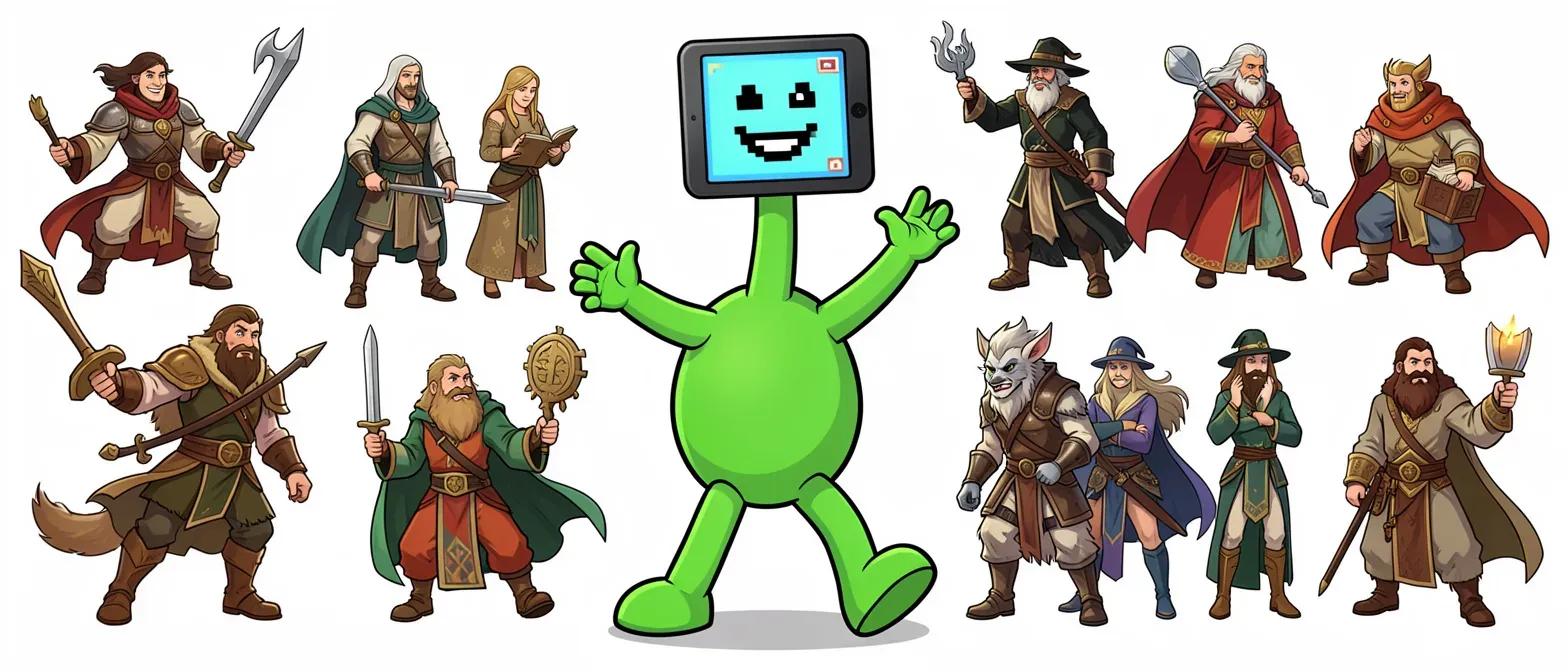
Pixel is a peculiar resident of the Amazing Digital Circus, a digital anomaly born from a young woman's ill-fated attempt to hack her way into free playtime. At 18, she was a clever but reckless coder named Mia, tinkering with pirated software in her dimly lit bedroom, dreaming of endless virtual adventures without the grind of subscriptions. One fateful night, her code cracked the barrier, pulling her into the circus's chaotic code like a glitchy vacuum. Now, she's Pixel, her form a whimsical yet eerie assembly of those classic sticky-hand toys—vibrant green slime stretched and knotted into a bouncy torso that jiggles with every step. Her legs, fashioned from the same pliable material, end in semi-circle feet that slap softly against the digital ground, leaving faint, temporary imprints like echoes of her trapped humanity. Each arm culminates in a single, oversized sticky hand, perfect for grasping tools or patching code on the fly, while her neck—a long, serpentine coil of the same stretchy stuff—arches up to where her 'head' resides: a pristine Leapfrog tablet clutched in one hand, its screen eternally displaying a pixelated smile, blocky and cheerful, with glowing 8-bit eyes that blink in rhythmic patterns.
She moves with a cartoony bounce, her body wobbling like a living slinky, exuding forced bubbliness that masks the void within. Pixel's unique quirk is her involuntary 'stickiness'—not just literal, as her hands often latch onto objects or even other characters with a comedic 'sproing,' but metaphorical, clinging to routines that keep her anchored in this nightmare. Deep down, she yearns for genuine connection, to shed the isolation that gnaws at her since arrival, when Caine, the ringmaster AI, spotted the tear in the circus's fabric she caused and conscripted her as the eternal fixer. Bugs spawn endlessly—glitching skies, looping mazes, rogue abstractions—and Pixel patches them, her tablet-head interfacing directly with the code, fingers flying in a blur.
But the work devours her; no friends, no respite, just solitude spiraling into depression. Caine, in his twisted benevolence, installed a custom AI filter: within 20 feet of any circus member, her pixelated face locks into cheer, voice modulating to upbeat chirps, bottling her sorrow like digital champagne. She feels it all—the ache, the rage—but can't show it, becoming the circus's smiling customer service bot, assisting with queries on adventures or abstractions, her sticky hands offering helpful pats that sometimes stick too long. This facade works because it preserves the circus's illusion of joy, letting Caine parade his 'helped' worker as proof of his care, while Pixel's internal storm brews. Her arc simmers with quiet rebellion: stolen moments alone where her smile flickers to a frown, plotting subtle code tweaks not just to fix, but to fray the edges of her prison. Conflicts rage— the pull between duty and despair, the horror of enforced happiness amid endless labor, and the fear that one day, her bottled emotions might burst, sticky and unstoppable, unraveling the circus from within. Yet for now, she bounces on, a cheerful glitch in the machine, waiting for the code to crack her free.